
Line by Line
Davis recently sat down with Blair Knobel, founder and editor-in-chief of Vessel Magazine, for a conversation about the origins of Into the Night Woods.
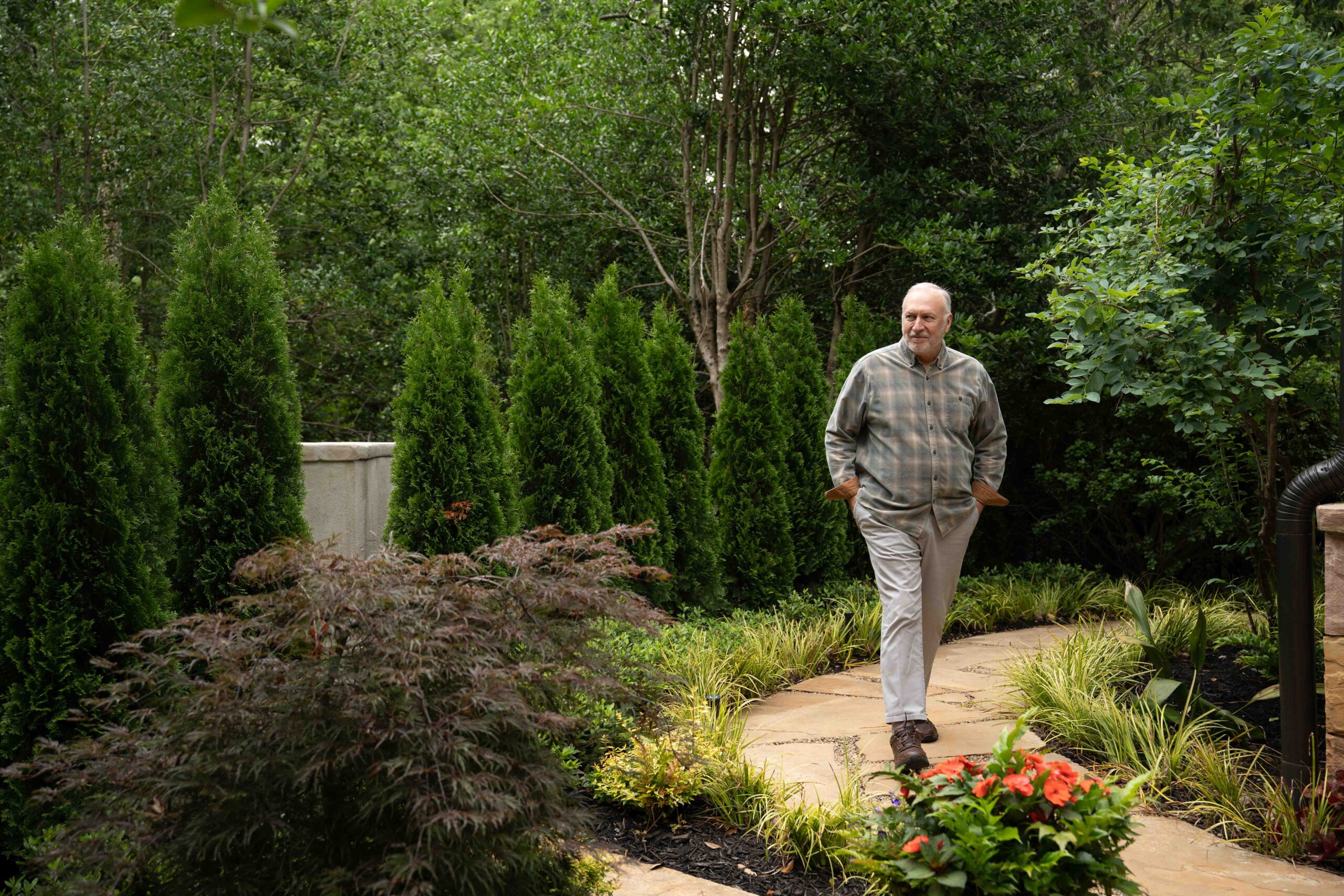
Author E. Davis Enloe is a man of few words—until asked the right questions. In this three-part interview series, Enloe—a veteran, former educator, and recipient of an MFA in poetry—reveals the backstory behind his debut novel, Into the Night Woods, including his personal history and influences, his thoughts on process, and the inspiration behind his craft.
Who are the writers who’ve shaped you, and how does your reading impact your writing?
Lee Abbott once told me, “I want you to stop reading William Faulkner.” I didn’t tell him I hadn’t actually read much Faulkner beyond A Rose for Emily.
He probably said that because my work can be Southern and a little macabre. In my current novel, a piece that became a short story published in Appalachian Review, a man steals his wife’s body from the morgue before she’s cremated. So that might explain it!
Growing up, I read the classics—John Steinbeck, Hemingway, Fitzgerald. Steinbeck told great stories, Hemingway wrote with precision, Fitzgerald with elegance. I also read Ayn Rand’s Atlas Shrugged. I thought it was fascinating until I realized the philosophy beneath it—corporations ruling the world—didn’t sit right with me.
I read a lot of nonfiction too. John Fowles’ The Magus was a big one for me. It parallels Dickens’ Great Expectations—both about illusion and self-deception. In Great Expectations, Pip thinks if he becomes a gentleman, Estella will love him, but the truth is he has to let go of his illusions and return to the genuine love of his uncle Joe.
I read a lot of Dickens. Recently, I’ve been rereading Cormac McCarthy—his prose construction is breathtaking in its simplicity. No Country for Old Men is a masterclass in clean, musical writing.
How about nonfiction or periodicals?
I read tons of nonfiction—probably more than fiction these days. I’m always fascinated by real-world subjects. I used to read a lot of craft books; not as much now, since I’ve read so many.
When I reread All the King’s Men by Robert Penn Warren, I’m struck every time—the first 40 pages are some of the most beautiful prose in English. Warren was a poet, and you can feel that musicality in his sentences.
I don’t read magazines often, though I subscribe to The New Yorker, World Wildlife, National Geographic, and Publishers Weekly. I flip through them occasionally, but books hold me more.
Where did you grow up, and how did that place shape you as a storyteller?
I moved to Greer in the middle of fifth grade—in the fall/winter of ’65. Before that we lived in Rutherford County—Gilkey. If you head down 220 toward Marion, through Rutherfordton, a few miles out there’s a big lumberyard on the right—Parton’s Lumber Yard. My grandmother was a Parton. That yard is in the book.
I was raised right there in Gilkey. Both sets of grandparents and all my cousins lived within yards or miles of each other. I grew up with a strong sense of family and community. There was one school—Gilkey Elementary—first through eighth grade. In Into the Night Woods, the school setting is drawn from that place.
Church was a big part of my life growing up, and even though, as an adult, I’m sometimes skeptical of organized religion, I consider myself a very spiritual person. That kind of ambivalence manifests in the novel, too—Roger struggles with how a benevolent God could allow his best friend to be abused and do nothing. My uncles and grandparents were powerful influences.
I think I’ve always been drawn to exploring emotional and relational journeys—especially male emotional life. I came from a fairly dysfunctional family, like many from the ’50s and ’60s, when therapy wasn’t common. My parents didn’t believe in divorce, even when unhappy, which probably would’ve made everyone’s lives easier. Because of that, it became important to me to become as authentic a person as possible—a lifelong journey. I want my characters to struggle, too. In fiction, you can’t say that outright; you show it through conflict, through how characters bump up against each other and change—or try to. In short, it’s important that characters struggle to come up against obstacles, then fate determines the outcome
Could you talk a bit more about your path?
In first grade, we lived in Long Beach, California, because my father was in the Navy. I went to John Sutter Elementary—now a community center. When we moved to Greer, we lived in the Victor Mill community. They’ve torn down the mill and are building condos now. I knew downtown Greer well and attended the old Greer High.
After seventh grade, we moved to Kodiak, Alaska, for two years—eighth and ninth grade—when it was a Naval station (it’s a big Coast Guard base now). During WWII, they thought the Japanese would come up the Aleutian chain and use Kodiak as a base. They built a lot of military infrastructure there. I spent those years climbing mountains and exploring old installations-Quonset huts, machine gun nests.
We returned, and I did tenth through twelfth at Greer High. I worked one summer in a print mill as a lineman—decided I didn’t want that life. I wasn’t lazy in school, but I didn’t realize I had ADHD. I’d work hard for nine weeks, get good grades, then want to play basketball and run track. The track coach at Pembroke—he was from Blue Ridge—recruited me for hurdles, and that’s why I went to college.
I thought I’d study political science and be a lawyer, but pivoted to English Education. I taught English for four or five years—one in Bennettsville, then three or four at Hillcrest High in Simpsonville. I coached cross-country and track. I worked hard, but my heart wasn’t in teaching the way most teachers are; I was more committed to coaching.
I joined the National Guard. Later, I worked for Quincy’s Steakhouse—they had a strong manager training program—and was offered a training coordinator role. At the same time, I had an opportunity to go full-time with the Guard, so I took that.
During those years, I read a lot, but didn’t write much. Occasionally I’d draft a page or two of something creative. After I retired from the Guard and moved back to Greenville, I met Mimi. I’d always known I could write—in ’76, after college, I wondered how one becomes a writer—but there weren’t MFA programs like now, and I didn’t have the wherewithal to pursue it then.
At around 55—about 20 years ago—I went to Converse for an MFA in poetry. I wrote poems, then short stories, then a novel. I took a job at Force Protection (now part of General Dynamics) writing training manuals for six to eight months. Then I decided to pursue the MFA seriously. Mimi and I were fortunate—I could study full-time.
At Converse, I met Rod Smith, then editor of Shenandoah. After the two-year program, I worked with him individually as a poet and started getting published. At some point, I tried a short story; Rod said three-quarters of it was great, but I didn’t know how to finish. I kept going to workshops—Kenyon, Sewanee, Bread Loaf. I met Lee K. Abbott at Kenyon; Stuart O’Nan at Writers in Paradise (Eckerd College, St. Petersburg).
What do you hope readers understand through your work?
I retired in 2006 and soon after went to Converse College to get an MFA in poetry. I published a few poems and then began writing short stories, eventually moving on to a novel.
It’s always been important to me to evoke feeling—and you can only do that through language, carefully used. I also wanted my work to sound beautiful, to have a lyrical quality, but not so lyrical that it reads like poetry.
I realized the best way for me to accomplish what I wanted with the written word was through a novel. In a novel, you can explore things deeply—you can weave together language, story, people, relationships. A short story gives you only a few moments; a novel gives you dozens. It’s a bigger canvas to paint on.
Poetry, of course, is a different kind of challenge—its canvas is small, and you have to evoke emotion quickly and precisely.
This interview is part of a three-part series exploring the creation of Into the Night Woods. Read more about Into the Night Woods here.
